Thinking about Black Women in Fim ….”Think Like A Man” and Others

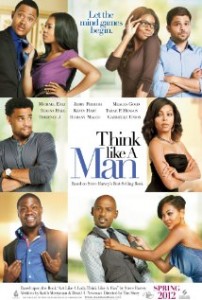
Think Like a Man made $33M in revenue this weekend.

Friday I saw Think Like a Man (blog post forthcoming). On Saturday I had a realllllllly long conversation with @starfishandcoffee on Twitter about the narrow representation of Black women in films, about the pervasiveness of patriarchal narratives featuring Black women in mainstream media (Think Like a Man, Woman Thou Art Loosed, Good Hair etc…) and about the need for more nuance in the representations of Black women.

@Starfishandcoffee was upset, and rightfully so about both the pervasiveness and the ubiquity of Think Like a Man. However, from my perspective these images are not only powerful because they represent Black women in mainstream media, but they are also powerful because I believe that being able to dominate someone culturally through representations of themselves, is connected to being able to dominate them both economically and spiritually.

There is something bigger here than just going to the movies.

A few years ago I wrote “culture is hegemony’s goon” when talking about the pervasiveness of patriarchal messages in a collection of  Beyonce’s songs.

This doesn’t mean that I don’t think that the audience has agency, that Black audiences can reclaim a text and see it in ways that helps them to see their own humanity. But I will tell you this, in a cultural context where George Lucas has to pony up his own money in order to produce and distribute a film about African American fighter pilot heroes because the films were not perceived as having in financial viability, globally, then we are dealing with a very particular economic context in which Black films are being made.

Filmmaking is capital intensive, meaning that it involves tons up up front money, and people with capital tend to be incredibly risk averse. So, if “the Black mammy”, or the maid “The Black lady” and “The Hoochie mama” entail a guaranteed return on investments, why would an investor support a story containing more nuanced images?

When I asked @starfishandcoffee why she appeared to be so invested in in mainstream films offering nuanced versions visions of Black women she responded saying that if we want to reach the masses of people, then engaging with pop culture will bring them in. She also stated that it is important to engage with pop culture because teaching visual literacy and criticism to young people is important. Lastly she stated that she doesn’t expect Hollywood to do the right thing (no pun inteneded) but that folks who want more nuanced images, need to push back against what is being served.

All of which I agree with.

But would be lying if I didn’t leave our conversation thinking about Ed Guerrero’s statements in the book The African American Image in Film about the economics of film, and the intersection of race and filmmaking. He writes,

Whatever its orientation, black cinematic expression, as much of black culture has nearly always been proscribed, marginalized, exploited, and often ignored. Thus black filmmakers of both persuasions are constatnly called on to create out of an uncomprimised, forthright perspective that recovers the long-suppressed sensibilities, apsirations, and narratives of the Black world and struggles to bring them to the cinema screen. At the same time, because movie making is such a captial intensive business and is so largely depended on mass markets, consumer trends and fiasions, these same filmmakers must appeal to a broad enough  commercial audience to earn sufficient revenues at the box office to ensure their candid atvisions of the black world to be successful. And what is equally important, that there work will be sustained in a  succession of feature films. In order words, the black filmmaker must struggle to depict the truth about black life in America while being inextricabily tied to the commercial sensibilities of a mass audience that is for the most part struggling to deny or avoid the full meaning of that truth.

The last bolded section helps to explain is why I believe that there is something bigger here than simply going to the movies. When people go to the movies they are learning how to relate and how to be. I think it also speaks to the constraints that filmmakers,who want to depict Black woman outside of the controlling images, the very restrictive constraints that they must face.

Thoughts?

Moving beyond The Mammie and The Hoochie Mama in mainstream film before 2020?
On Black Women’s Sexuality


The second time that I saw Pariah I decided to change my paper’s title, or even to give it a proper title because of the direction  the paper is taking. The working title is “I am Not Broken, I am Open: Toward  Hetergenous Representations of Black Women’s Sexuality”.

After walking around with a notebook and several drafts two Saturdays ago, and reading and re-reading what I wrote, it became clear that I was not only interested in how Black women make choices about their sexualities, but that I was interested in the politics of Black women’s storytelling both on a day to day basis and on film. In fact, my interest in the politics of Black women’s storytelling is probably why I chose oral interviews as one of my methods of the paper that I have been working on.

There is a parallel between Black women’s lives and Black women’s films when it comes to how and when we are able to represent ourselves. In fact, now that I think about it, I am completely invested in interrogating how public and private marketplaces shape how Black women make choices about their sexualities AND how they shape the stories that Black women are allowed to tell publicly, on a large scale to other Black women.

Gina, this is not what I set out to write about, but this is what nags at me both in my day to day life, and it keeps coming up as I read the paper, so rather than fight it, I will embrace it. I realized, only two weeks ago, that the paper is about these two things. I am not sure what to do with it, now that I have recognized it, but I know or at least I hope that there is some way for me to address it in material ways.

I chose the I am not broken, I am open for a few reasons. First  because it is a line of a poem that Alike says in Pariah. I also use it because Dee Rees wrote the poetry for the film. The third reason is because that line in the film speaks to a previous idea that I have stated which is that “Being read as deviant has fractured the space for Black women to discuss their sexuality”. I have a host of ideas about saying this both on my blog and saying it publicly. I am simply not certain that Black women can re-claim something that has suffocated their humanity. Even as I write that I ask, is that binary thinking, do the films that I have watched, the interviews that I have conducted and even the conversations that Ih ave had with my friends about Black women’s sexuality tell me something different?

I don’t know.

Is Marriage Really for White People Gina?

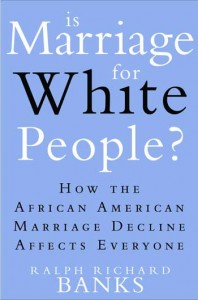
For my paper, I read Ralph Bank’s “Is Marriage for White People?” Banks is a legal scholar and professor at Stanford University.

This text is crucial in terms of the “Middle class Black women can’t find a man” discourse because it is both a scholarly book and because it has been reviewed widely in the popular press. In the book he provides research on Black women and marriage and he also cites his his own findings from interviewing middle class heterosexual Black women from across the US.

He essentially states that middle class heterosexual (MH) Black women are the most unmarried population in the US, that middle class Black women will marry someone who earns lower wages than they do, but they are reluctant to marry outside of their race. He states that across race Americans are less likely to be married now than they have been historically. In looking at Black women, he says that we can see how “Black people  are at the center of a social transformation  whose reverberations encompass us all”.

He concludes that MH Black women may want to consider marrying outside of their race because Black women’s dating market is highly segregated and when MH Black women marry outside of their race “the Black gender balance becomes a little less severe”.

Historically, marriage has been an economic, legal, familial and property arrangement. This is not to say that Black women are wrong for desiring it, as it is not my place to say. I will, however saw that I am very skeptical at this particular moment of any narrative that delves into the lives of Black women, that is not told by Black women.  I am not saying that Black women offer a “truth” as Black women, as I believe in the heterogeneity of Black women. We are not the same. I am also skeptical of narratives that do not explicitly acknowledge the context in which they exist.

While the book does acknowledge how labor an employment opportunities may shape marital statistic a more indepth conversation about labor and gender roles would have been useful. Our economy both in the US and globally is undergoing a major restructuring and I posit that this is having a major impact on the choices that heterosexual middle class Black women make. Changes in educational attainment for women across race, changes in technology and how technology shapes employment and the global movement of capital impacts all of our lives on a day to day basis. These social forces are impacting the lives of all adults, so they impact Black women as well.

There are some interesting tidbits in the book.

First he states that while popular media discourse paints MH Black women as “too picky” he has found that MH Black men are the ones who are in fact picky. He makes this statement for two reasons. First, the variety of women that the MH Black men have access to makes it less likely that they will desire marriage as they may want a woman who represents a combination of all the best attributes of the women that they currently date. This is a profound point.

His second tidbit is that MH Black men are less likely to think that their sexual life will improve with marriage. Sexual politics within monogamous and non-monogamous relationships are dynamic, negotiated and vital.

The third tidbit is that both many Black men and Black women assume that Black men are the only option for MH Black women. According to his interviews, Black women want to marry a Black man, so that they can have Black children. They see partnering with Black men as “fighting racism” because “we should never give up on our Black men”. However statistically, MH Black men have not been committed to marry MH Black women. And there is the rub gina.

The fourth tidbit is that Black women who date white men report more acceptance of their natural hair from their White male partners. I thought this was really interesting. I would like to see a conversation online about this!

The fifth tidbit is that he cites research which states that lighter skinned Black women tend to marry higher earning Black men, in comparison to their darker skinned counter-parts. In terms of erotic capital, I find this finding fascinating.

There are three things that could have been done in this book that were outside of the scope of the project as it stands today, but it would have made a more richer discussion.

It would have been interesting if he devoted a section of the book to looking at MH Black women who have been both married and divorced. Hearing them speak about the current discourse around Black women and marriage, having been married gives them a vantage point that could make for a much more nuanced and richer conversation.

The second thing that I would have liked to have seen explored more is the decline of the middle class in the US and the low marital rates of MH Black women. Place their marital options, choices and patterns within this context would make for a more nuanced conversation.

Many of the women he interviewed are either middle class, or high income earners. Statistically these African-American women are likely to be  “the only one” within their companies. As Black women they deal with both racism and sexism, and depending on their class background classism as well. It would have been interesting if he opened up a conversation about how middle a middle class or high income earning Black woman shaped her willingness to get married. Or to put it another way, how does navigating racism and sexism at work, the loneliness of this space impact Black women’s desires to marry. Giving the health statistics of around Black (and Latina’s) health in the academe, I wonder to what extent does navigating work issues of race and gender shape Black women’s desires to marry.

By and large the book is an interesting read, even if the title is in many ways sensational.

So, having written all of this I am left with a few questions.

When will he have a conversation about how dealing racism and sexism at work may or may not influence MH Black women’s desires to get married?

What does it mean that so many institutions are examining the marital desires of Black women?

Is this another way to call Black women deviant?

On Black Girls and Pleasure

Waaaaay back in 2008 I wrote a blog post in the summer time, right after we learned that Erykah Badu was pregnant with her little bear about the fact that Black women’s bodies do not belong to themselves.

Looking back I realize that I was inspired by the fact that that in public people feel entitled to touch our hair and our bodies, and in private our families and loved ones feel that they have say so about our hair texture (nappy vs. straight, or re: going natural).

So. This brings me to this morning when I finally figured out WHY I am writing about Black women’s sexuality.

Saturday, I got no work done. Nonya. This was the first time this year where my schedule got completely upended.

Last semester was on #Aquemini Saturday. My boo’s do be my muses. o.0

Rather than go to read and write on Saturday morning, we drove to Balitmore for brunch and that shit was luxurious.

Then I slept. Then we went to the movies.

Granted, I was behind as shit on Sunday, because so many chores didn’t get done.

So this morning, I was saying that I wanted to GO BACK to Saturday; It was impromtu and fun; it felt like a vacation.

Then Goldy turned around and called me greedy. I was like, “I am greedy because I want to hang out the you and not be running 5011 errands for two or three hours straight?” “I don’t think it’s greedy, I think I am being a human being.” She got my point.

It was in THAT moment that I realized why I have been writing about and invested in Black womens sexuality and the social and economic forces that shape how Black women make sexual choices at home and in public.

Many of us are told by our mothers that all we need to do is “work” because “you can do bad all by yourself.”

When many of us were little, language is used with Aunt’s, Uncles, and grandparents to discourage them from giving us stuff or being nice to us otherwise we may get “spoiled.” Spoiled food is rotten and inedible.

All of this leaves me with a few questions.

Out of a desire for our mothers to protect us, and make sure that we have tools to deal with a fucked up world, did they make Black girls and pleasure two mutually exclusive categories?

Did our mothers socialize us to run away from pleasure?

Does enjoying pleasure mean being “ruined”? Ruined for who?

Why are the boys in our family not talked about in the same way?

Are the boys in our family ever described as being “spoiled?”

Does it have the same meaning when it is used to describe girls?

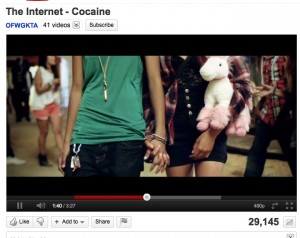
On Syd the Kid’s “Cocaine” Video


I have contended that in a world premised on oppressing women, openly Loving a woman is probably one of the most radical things you can do.

The homie @danyeezy, just put me on to the new Syd the Kid video. Syd is the only woman member of OFWGKTA . @Danyeezy reblogged a link to Syd’s video “Cocaine” from the blog Life is Fair Game.

I watch videos with the sound on and with the sound off because it helps me to focus on the images.

I also teach my students do so because a music video combine text with images, which makes them very powerful.

The song, the instrumentation of it is hot. Sounds like Pharell with…I don’t know a funky Fiona Apple.

I also enjoyed the non-normative gender presentations of Black girls IN A MUSIC VIDEO.

Queer Black girls are not featured in music videos.

However, as I listened to the song, I thought, is she saying “I wanna, I wanna, Do you wanna do some Cocaine?”

Why yes, she is.

I get it, sex, drugs, and rock and roll.Historically young people in general and young artist in particular have said and done outlandish things to stand out and rebel against their elders.

However, bodies have histories, and Black girl’s bodies certainly have histories.

Which brings me to a point.

In order to see masculine and feminine identified young Black women in a music video, the narrative is going to pivot on them “doing cocaine” together?

Given the history of both crack and cocaine in Black communities throughout the US historically, is “doing coke” something to sing playfully about?

Is this cost of entry to high of a price to pay? In other words, if the trade-off for having queer young women of color being represented in pop culture is the that they are performing “do you want to do some cocaine” and talking about “slapping bitches” is it worth it?

Is the trade off for being vulnerable and willing enough to grab a woman’s hand in a video that you to also be willing to say that you like “slapping bitches”, is that too high of a price to pay to BE visible in the first place?

Perhaps it is easier to talk about slapping “Bitches” than it is to be vulnerable. ~#allcity

On whose terms should Black girls be represented? And why?


Will Learning How to Pole Dance Keep Your Hetero Man Out of the Strip Club?

The homie Britni Danielle @ Clutch has an interesting article up, “Please, Baby Please” about the politics of Black heterosexual relationships.

The piece starts off in response to an article by Janelle Harris “Whatever it Takes to Please a Man”.

Janelle discusses how she considers that when her boo snack goes to the strip club that it is right up there with cheating. I appreciate her post because it is honest. It is not easy to write publicly about things about yourself that you are not proud of. I have done it before. It is not a game.

I also find Janelle’s piece interesting for two reasons.

First, she assumes that she can satisfy her boo snack by learning how to pole dance, and this will keep him from going to the strip club.

The thought that came to mind is paying a woman to allow you to touch her is an act of power in an economy that does not pay women the same as their male counterparts. If women earned the same as men for doing the same jobs and if women were trained and allowed and supported to do high income earning jobs, there would be fewer working in strip clubs. (Goldy and I tried to go to a strip club two months ago, they would not let us in. There is a post collecting dust in the drafts section about that excursion. o.O)

Second, Janelle is acutely aware of the fact that she is trying to be superwoman, she knows that it isn’t achievable, but is trying her damnedest to do it anyway.

During comps, at night I would read parts of Siohban Brook’s “Unequal Desires: Race and Erotic Capital in the Stripping Industry” which is a book about how race, skin color and body size impacts the money that women earn as strippers. She actually goes into the strip clubs and interviews men. I am inspired by and influenced by her work. Reading her work kept me going.

The whole time I am reading Janelle’s piece I am thinking of the fact that Brooks went into the strip clubs in the Bronx and in Midtown in New York city and asked men why they go. I also wondered what does Janelle’s gentleman friend think about her ideas around pole dancing and cheating. Because baby let me tell you, people buy what makes them feel comfortable.

So, in Britini’s post she says it makes sense that someone does the things that they need to do to make their boo snack happy. If this means, for instance, taking a cooking class to make the kind of food that your boo thang likes; then, this makes sense.

She then takes an informal poll of some men that she knows and asks them,

 if they thought it was necessary for both parties to cater to one another in a relationship, and if they looked at women who seemingly went above and beyond the call of duty to please her mate any differently. To their credit, all of my brethren confirmed that they love to both please and be pleased by their woman. The guys felt giving was a necessary part of a relationship because it showed that both parties valued each other. But with one caveat. While they would like their woman do whatever freaky, sneaky (or otherwise) thing they desired, they overwhelmingly agreed that she should never do anything that made her uncomfortable just because he might like it, because they, for damn sure, wouldn’t either.

I thought that there was a bit of posturing here because of the issue of oral sex. I theorize that Black women are reluctant to perform it because of “the ho tape”, peace to Josephine. If I were Britni I would have asked them, if their lady friend does not perform oral sex, does this change how he see’s her? I would have also asked them if they would reciprocate.

She then goes on to conclude that,

On the contrary, today love is seen as something relegated for chumps. If a man does something nice for his woman/wife, he is called “whipped,” a “punk,” or less than a man. And if a woman wants to go out of her way to try something new to please her man, she’s sometimes called “desperate,” “thirsty,” or charged with having low self-esteem.

While I do agree that there is some cynicism and skepticism around Love, I would conclude that before we can talk about, or while we talk about the politics of gender relations between Black men and women, we also have to talk about how we Love ourselves.

For a fact, dead assed serious, the more I have come to Love myself over the last four years, the more it is reflected in not only the kind of person that I attract, but also the kind of person that I choose to date and remain with.

Notice the distinction between attract and choose to date.

Last year, while dating a giver, it upended me, because while I was interested in the relationship, I wasn’t ready to go whole hog. It was a bugged out experience to have someone be so daggumit nice to me, and for me not to want to run off and get murried. To just be able to sit still and enjoy being doted on was lightweight revolutionary not only for my sense of self, but also in terms of setting the standard for all future boo snacks.

I do think that there is a reading of being invested in someone as being willing to be vulnerable. I also think that being nice can be perceived as being “whipped” or “thirsty”, but I think we need to rethink both how we see Loving others and Loving ourselves as well.

In fact, earlier this summer a friend, a little bear who is younger than me, suspected that her girlfriend was doing some shiesty shit. She said she wanted to stay with her. I asked her, dead ass, “What does loving yourself look like in this moment?” #Ummhmm.

What I am getting at is the ability to Love ourselves is connected to our ability to Love other people. Trust, having loved a selfish one or two there is a world of a difference.

Being vulnerable doesn’t mean being someone’s rug. The goal is to be vulnerable y fearless. #boom.

What’s the Difference Between a “Ho”, Housewife and Your Sister?


Nothing.

I woke up thinking about the way the women are put into categories and are ranked hierarchically.

For example, on any given Sunday in a barbershop, you can hear hetero African American men saying, “You can’t turn a “ho” into a housewife”.

Or on any given Friday night you can find hetero Black women saying “Girl, he wants a lady in the sheets, and a freak in the bed.”

I am sensitive to how women are put into the sexual binary (ho/housewife) than ranked as Loved/ain’t worth shit because I am currently in the thick of creating the arguments for a paper on Black women’s sexuality.

I am also teaching gender theory, so to watch how my students are either uncomfortable, or comfortable with being made aware of how they rank and treat others is enlightening.

In productive meeting with my boss last Wednesday  I said that I included a section on “Naming, Hearing and Seeing Black Women’s Sexuality” because “being read as deviant has fractured the space for Black women to discuss their sexuality.”

She then turned around and said she was going to contradict me. And while she did not contradict me, she forced me to see how powerful the word “fracture” was in that sentence.

By using fracture, I meant impacted and broken. She read it to say that a fracture does entail small breaks, but fractures create space, small spaces. And if a fracture doesn’t heal, like a bone, then it breaks completely; there is a big space.

I was like holy shit.

She then said that what I am saying is in many ways different from what twenty years of Black women scholars have been saying who have been talking about sexual silence, sexual taboo’s etc.

This was riveting.

She finally said that I was “reclaiming deviance.”

Context. In order for US chattel slavery to “work” Black women had to be described as subhuman and “natural” whores. We were lewd, lascivious and deviant.

I mean really, in order to enslave a woman, and her children, and rape her, and have her work in the fields picking cotton, slave owners had to figure out a way to make us “natural” whores.

While I know that in my day to day life, there is a reclamation of  “being deviant”. I had not idea that the shit was in my work as well. #Ha.

With regard to reclaiming deviance, I still didn’t know what she meant. So she used the example of how “Queer” has a history of being a derogatory term.

Light bulb.

I then said, wait the implications of this are huge because by saying this, it is almost like the “Slavery in the US benefited Black people argument”, you know the one about the “happy slave”. I also said that I am not comfortable defending that publicly.

She said that I didn’t have to be, but I should just think about my ideas of deviance and Black women’s sexuality and what that can possibly mean for my work.

It isn’t so much of being deviant, as it isn’t allowing white and black historical generated ideologies of what “proper Black femininity” (ho/housewife) looks like shape how I roll.

So, what’s the difference between a ho, housewife an your sister? Nuffin.

What’s the Difference Between a “Ho”, a Housewife, and Your Sister?


Nothing.

I woke up thinking about the way the women are put into categories and are ranked hierarchically.

For example, on any given Sunday in a barbershop, you can hear hetero African American men saying, “You can’t turn a “ho” into a housewife”.

Or on any given Friday night you can find hetero Black women saying “Girl, he wants a lady in the sheets, and a freak in the bed.”

I am sensitive to how women are put into the sexual binary (ho/housewife) than ranked as Loved/ain’t worth shit because I am currently in the thick of creating the arguments for a paper on Black women’s sexuality.

I am also teaching gender theory, so to watch how my students are either uncomfortable, or comfortable with being made aware of how they rank and treat others is enlightening.

In productive meeting with my boss last Wednesday  I said that I included a section on “Naming, Hearing and Seeing Black Women’s Sexuality” because “being read as deviant has fractured the space for Black women to discuss their sexuality.”

She then turned around and said she was going to contradict me. And while she did not contradict me, she forced me to see how powerful the word “fracture” was in that sentence.

By using fracture, I meant impacted and broken. She read it to say that a fracture does entail small breaks, but fractures create space, small spaces. And if a fracture doesn’t heal, like a bone, then it breaks completely; there is a big space.

I was like holy shit.

She then said that what I am saying is in many ways different from what twenty years of Black women scholars have been saying who have been talking about sexual silence, sexual taboo’s etc.

This was riveting.

She finally said that I was “reclaiming deviance.”

Context. In order for US chattel slavery to “work” Black women had to be described as subhuman and “natural” whores. We were lewd, lascivious and deviant.

I mean really, in order to enslave a woman, and her children, and rape her, and have her work in the fields picking cotton, slave owners had to figure out a way to make us “natural” whores.

While I know that in my day to day life, there is a reclamation of  “being deviant”. I had not idea that the shit was in my work as well. #Ha.

With regard to reclaiming deviance, I still didn’t know what she meant. So she used the example of how “Queer” has a history of being a derogatory term.

Light bulb.

I then said, wait the implications of this are huge because by saying this, it is almost like the “Slavery in the US benefited Black people argument”, you know the one about the “happy slave”. I also said that I am not comfortable defending that publicly.

She said that I didn’t have to be, but I should just think about my ideas of deviance and Black women’s sexuality and what that can possibly mean for my work.

It isn’t so much of being deviant, as it isn’t allowing white and black historical generated ideologies of what “proper Black femininity” (ho/housewife) looks like shape how I roll.

So, what’s the difference between a ho, housewife an your sister? Nuffin.


He is Such a Gemini.

#ummhmm.<<<<Click.

I Live for the day when a Black woman can be this THIS explicit and unapologetic. Publicly.